Why Does My Commercial Roof Keep Leaking Even After It Was Replaced?
Sometimes the membrane is not the root problem. Drainage, slope, scuppers, ponding and the way water moves across the roof may be what actually needs to be corrected.
Read the answers →QUESTION 02Electrical and Mechanical Thermography: What Does a Hot Spot Actually Mean?
Finding heat is easy. Determining whether it represents abnormal resistance, load, friction, reflection or normal operation requires context.
Read the answers →QUESTION 03Can Infrared Thermography Find Moisture Under a Commercial Roof?
Infrared can reveal thermal behavior consistent with trapped moisture, but the thermogram is evidence to investigate — not a picture of water beneath the membrane.
Read the answers →QUESTION 04How Reliable Is Infrared Thermography as Evidence?
A compelling thermogram is not automatically a defensible conclusion. Reliability comes from the chain connecting the question, conditions, acquisition, interpretation and verification.
Read the answers →QUESTION 05Does Prop Wash Affect Thermal Imaging?
A thermal drone changes the environment it is trying to observe. At low altitude, rotor wash can become part of the measurement problem.
Read the answers →QUESTION 06How Do I Plan a Defensible Thermal Drone Mission?
A good flight plan tells the aircraft where to go. A good thermal mission plan explains why it is going there, when it should observe, and what evidence must come home.
Read the answers →QUESTION 07How Do Environmental Conditions Affect Thermal Imaging?
Wind, sun, shade, terrain, nearby buildings and thermal history can change the image before the camera ever sees it.
Read the answers →QUESTION 08Can Thermal Imaging Find Water Intrusion, Moisture Migration or Drainage Problems?
Thermal imaging can reveal where a surface behaves differently. Determining why it behaves differently requires context, terrain, timing and ground truth.
Read the answers →QUESTION 09What Is Emissivity — and Why Can It Change the Temperature I Measure?
A simple camera setting can become a large measurement error when the surface does not behave the way the operator assumes.
Read the answers →QUESTION 10What Is IFOV — and How Close Do I Need to Be for a Reliable Thermal Measurement?
Distance, detector resolution and target size determine whether the camera is measuring the object you care about or averaging it with everything around it.
Read the answers →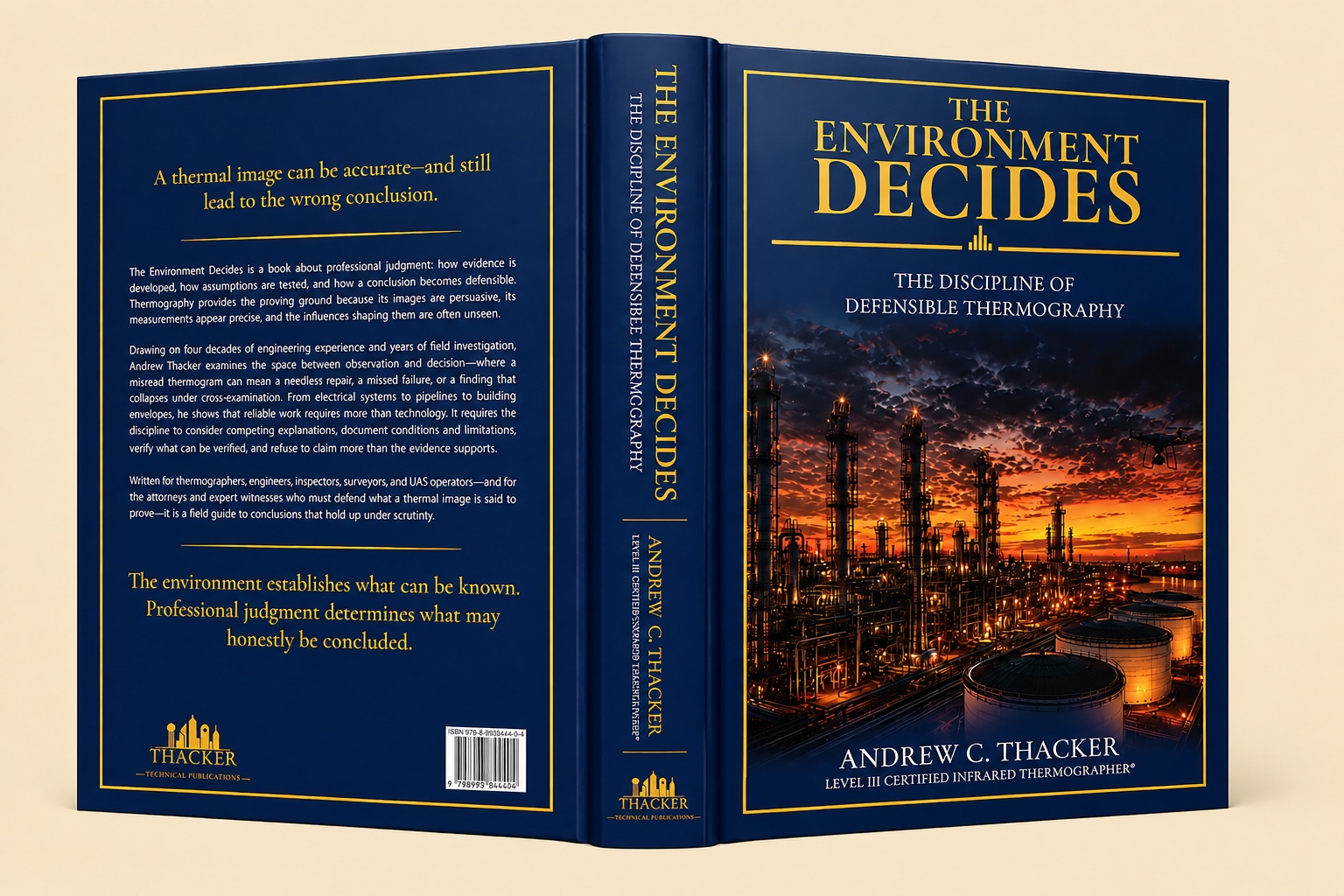
The Environment Decides
The questions explored here are part of a much larger discipline. The Environment Decides: The Discipline of Defensible Thermography, by Andrew C. Thacker, examines the environmental, physical and practical factors that influence how thermal evidence is acquired, interpreted and ultimately defended.
It is designed to serve as a planning reference before the mission, a field reference when conditions change, and a shelf reference when an unfamiliar problem demands a deeper answer.
The objective is not simply to collect better thermal images. It is to understand what those images can — and cannot — tell you.