
The boundary of the measurement
Before examining a single roof, the thermographer must understand the boundaries of the measurement. Infrared thermography is a powerful tool for detecting moisture in roofing systems, but it is not a universal diagnostic instrument. It reveals patterns of surface temperature that may indicate the presence of moisture beneath the membrane. It does not see moisture directly.
The detector records emitted and reflected radiance from the roof surface. That radiance is influenced by many factors: the membrane's emissivity, the thermal conductivity of the insulation beneath, the depth and extent of any moisture present, the time of day, the prior day's solar loading, the wind speed during cooling, the presence of reflective coatings, and the condition of the membrane itself. The thermographer must interpret those patterns through the lens of physics, not through wishful thinking.
Infrared cannot determine the precise moisture content of insulation. It can identify areas where the thermal signature differs from what a dry roof would produce under the same conditions. The thermographer's role is to locate those areas and recommend appropriate verification.
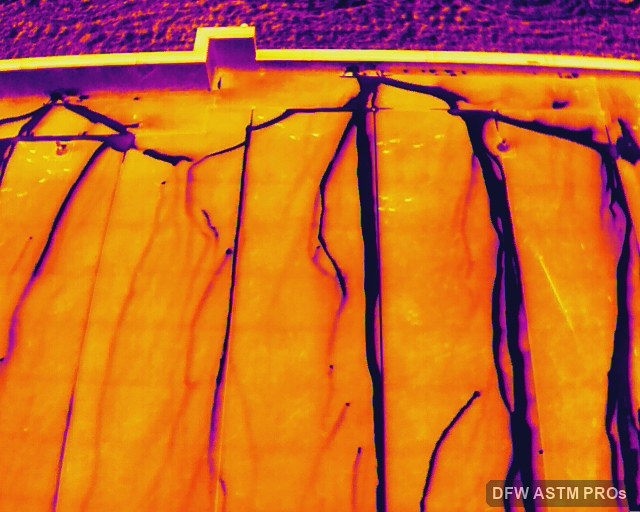
TPO and PVC: the confidence trap
If you are new to roof thermography, TPO and PVC will make you feel smarter than you are. The thermal signatures form early, emissivity is predictable, and the stark contrast between wet and dry can convince you that you have mastered the craft.
That confidence is the trap.
These roofs are the easiest to read correctly, and the easiest to misread with absolute, unshakable certainty. They teach the most dangerous lesson in thermography: that a clear image is the same as a correct interpretation. It is not.